Copy Trading Mechanics: How Mirroring Works
Updated 2026-06-16 · 8 min read
Copy trading on OptionsHood is not signal forwarding. It is broker-to-broker trade mirroring. When a leader's order fills, the platform calculates and submits equivalent orders to each follower account.
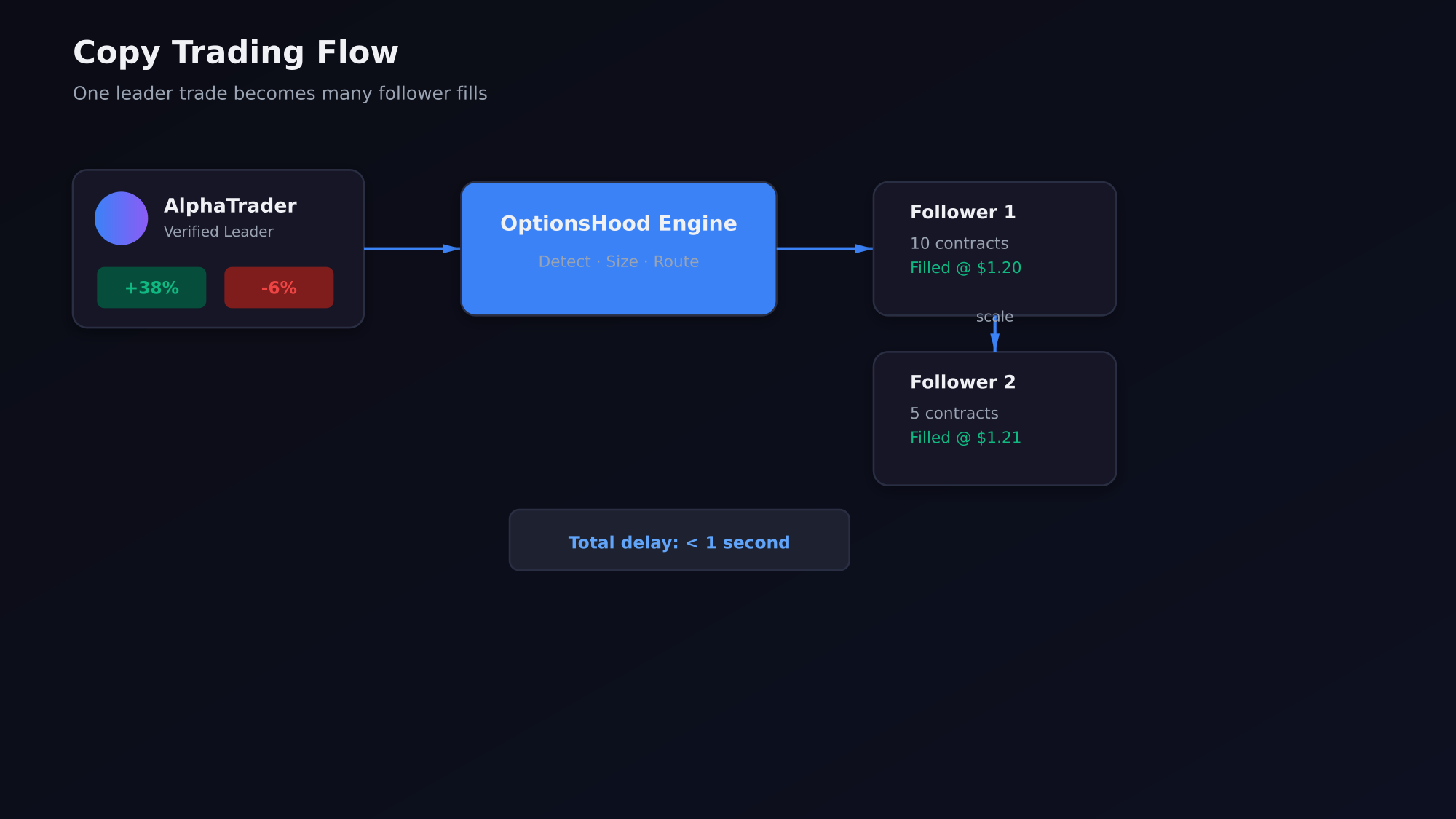
Step 1: Leader order executes
The leader places an order in their own broker account. OptionsHood detects the fill via API, usually within 200-500 milliseconds.
Step 2: Sizing engine runs
The platform applies each follower's allocation rule and rounds to the nearest valid contract or share size. Buying power checks happen before order submission.
Step 3: Follower orders submit
Orders are sent to each follower broker. Limit orders use the leader's fill price plus an optional slippage buffer. Market orders fill immediately but may experience slippage.
Step 4: Lifecycle sync
When the leader modifies or closes a position, the same action is mirrored. If a follower order fails, the platform retries once and then alerts the follower.
Execution delay
Typical end-to-end delay is under 1 second for liquid options. Slippage depends on market conditions and the follower account size relative to the leader.